1790
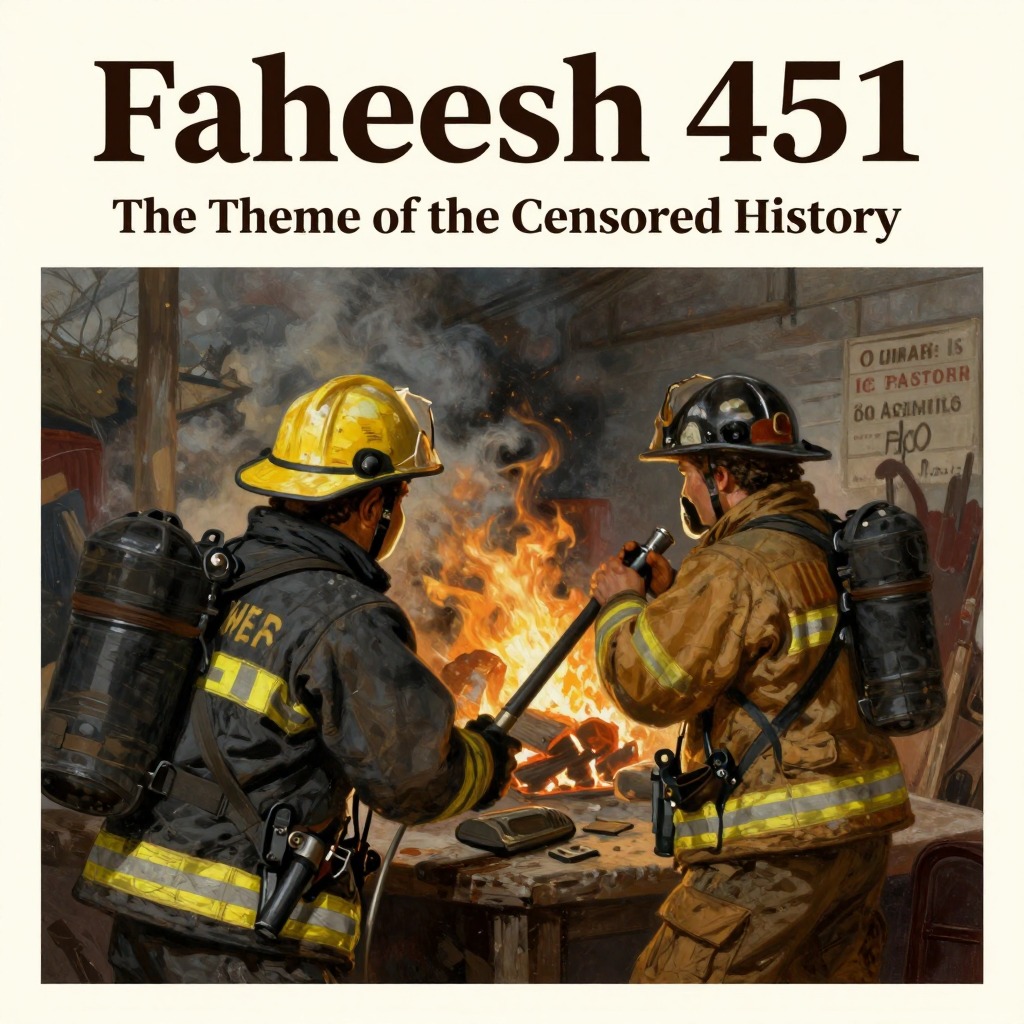
The year 1790 is the official founding date of the Firemen of America, a cornerstone of the dystopian society's historical narrative that Montag and his colleagues are taught to accept without question. This date, enshrined in the firemen's rulebooks, establishes a false origin story for the profession, one that Montag begins to doubt as he questions the very nature of his work and the society it serves.
Official History and Its Purpose
According to the rulebooks that Stoneman and Black produce for Montag, the Firemen of America were "Established, 1790, to burn English-influenced books in the Colonies." The first fireman is identified as Benjamin Franklin, a deliberate and ironic appropriation of a founding father to legitimize the censorship apparatus. This official history is presented as a set of immutable facts, alongside the five rules that govern the firemen's actions: answer the alarm swiftly, start the fire swiftly, burn everything, report back immediately, and stand alert for other alarms. The date 1790 is thus not a neutral historical marker but a tool of ideological control, designed to give the firemen's destructive work a sense of tradition and patriotic duty.
Montag's Challenge to the Narrative
Montag's growing unease with his role leads him to question this foundational myth. During a card game at the firehouse, he hesitantly asks, "Was—was it always like this? The firehouse, our work? I mean, well, once upon a time..." This question, which echoes Clarisse McClellan's earlier inquiry about whether firemen once put out fires, is immediately met with Captain Beatty's sharp rebuke: "Once upon a time! What kind of talk is THAT?" Montag's attempt to probe the historical narrative is a direct challenge to the authority of the state, and Beatty's reaction underscores the danger of such curiosity. Montag's own voice falters, and he finds himself speaking with Clarisse's words, asking if firemen once prevented fires rather than starting them.
Beatty's Revisionist History
Later, when Beatty visits Montag at home, he offers a more sophisticated, revisionist history of the firemen's origins. He dismisses the 1790 date as a rulebook fiction, claiming that the profession "really got started around about a thing called the Civil War." Beatty's account traces the rise of mass media—photography, motion pictures, radio, television—and the subsequent simplification of culture, which he argues made books obsolete and firemen necessary as "custodians of our peace of mind." This alternative history, delivered with Beatty's characteristic erudition and cynicism, is designed to confuse Montag and to undermine any simple faith in the official narrative. Beatty's version, however, serves the same ultimate purpose: to justify the firemen's role in suppressing dissent and maintaining social conformity.
Thematic Significance
The contested date of 1790 encapsulates the novel's central theme of historical manipulation. The society of Fahrenheit 451 has replaced genuine history with a self-serving myth, one that Montag must unlearn in order to understand the true nature of his world. The year 1790 is not merely a date; it is a symbol of how power constructs the past to control the present. Montag's journey from accepting this date as fact to questioning its validity is a crucial step in his broader awakening, a process that ultimately leads him to reject the firemen's entire mission and to seek out the forbidden knowledge that the official history was designed to erase.